Empire of Dreams and the Need for an Author Like David Lynch

John Rodolfo Franzoni
Edited by: Marco Aurélio Lucchetti
From a filmmaker like David Lynch, who passed away on January 15, 2025, at the age of seventy-eight, film admirers can expect an endless range of sensations and audacity, but never experimental concessions or anything palatable to a wide audience. It was he who, upon making his directorial debut with... Eraserhead (1977), a cult classic about a man's obsession with a fetus, received the remarkable nickname from Mel Brooks of “"Jimmy Stewart from Mars"”. With The Elephant Man (The Elephant Man, (1980), received critical acclaim for narrating the true and terrifying story of a deformed man exhibited as a circus attraction in Victorian England. And, with Blue Velvet (Blue Velvet, 1986), an idiosyncratic, strange, but above all fascinating vision of what lies behind the elegant facades of American suburbs (it is worth remembering here that, in the series Twin Peaks, Lynch, who sought to unveil the dark and unsuspected side of the lives of ordinary people in a small town in the United States, was acclaimed as one of the greatest American directors to emerge in recent decades. Even when he dedicated himself to a work... “"free censorship"”, the simple True Story (The Straight Story, 1999) – the film tells the story of a farmer who, penniless, undertakes a journey of several weeks aboard his old tractor in order to visit his brother, whom he hasn't seen for many years, is ill and lives on the other side of the country – he permeated the film with a captivating slowness and a contemplative tone rarely seen in uplifting cinema.

Kyle MacLachlan and Isabella Rossellini, in a scene from Blue Velvet.
In 2006, David Lynch delivered yet another masterpiece: Empire of Dreams. And we can't talk about Empire of Dreams, without mentioning the director's previous film: City of Dreams (Mulholland Drive, In his film *The Dark Knight Returns* (2001), Lynch, narrating the story of a brunette with amnesia (Laura Harring) and a blonde aspiring to stardom in Hollywood (Naomi Watts), used an exemplary dreamlike connotation to investigate both the existing collusion in the capital of American cinema and to confront comfortable ideas held by the viewer regarding narrative linearity, armed with two actresses in a state of grace [in the film, Naomi Watts reveals herself as a volcano of unsuspected layers, something not seen since Kathleen Turner in her...]. debut in Burning Bodies (Body Heat, 1981); and, in a touch that is both brilliant and a tribute to Alfred Hitchcock (1899-1980), she is seen wearing the same pantsuit as Madeleine Elster, Kim Novak's character in A Body That Falls (Vertigo, 1958), the magnum opus on the duality of human nature].
In City of Dreams, David Lynch leads an unprepared audience into a unique experience, similar to that which we experience during a dream: events lose their logic, personalities are inverted, beings and events seem not to fit into the reveries produced by the human brain when asleep. And he does this with an invasive camera, which captures gazes in an overwhelming way; and a production worthy of applause, crowned by yet another exemplary soundtrack by Angelo Badalamenti (1937-2022), his usual composer.

Naomi Watts and Laura Harring, the main stars of City of Dreams.
And if, at the end of the projection of Empire of Dreams, We feel a certain frustration, which is certainly due to our eagerness to deliver a treaty worthy of the impact of City of Dreams, which earned Lynch a third, and unsuccessful, nomination for Oscar Best Director. However, this is merely a matter of redirecting that expectation. It's impossible to escape unscathed from the labyrinth of daring and craziness that the protagonist of... Empire of Dreams decides to explore. The most linearity extracted from its plot – a challenge for any critic or promoter – is that Nikki Grace [Laura Dern, the filmmaker's muse, already seen in Blue Velvet e Wild at Heart (Wild at Heart,[In 1990], a movie star is cast in the lead role of a Hollywood remake of a Polish production considered cursed and even aborted during its production decades ago. As Nikki's dedication to her role clashes with rather bizarre events, we witness a distortion of locations and characters with Lynch's unmistakable signature, who, this time, seeks parallels in Alice's Adventures in Wonderland, From Lewis Carroll's novel, to weave her journey – a journey that, the less patient will say, makes no sense whatsoever. The clues are all there: with her irrepressible curiosity, Nikki accesses the various doors located in unexpected corners, encountering scenarios inhabited by families of rabbits, Polish smugglers, and figures prone to a considerable array of barbarities. It is not advisable to interpret or find links to such narrative devices. The attentive viewer knows that they work perfectly for the final whole and that rejecting the linearity combated by Lynch serves, at worst, to refine discussions about the role of the artist and their power in defending a thought or style. There is the haste of those who prefer to attribute pretension, charlatanism, or elitism to this type of conduct – territory where the professionals of Cinema Novo reign unbeatable. However, such thinking is typical of those accustomed to an analysis lacking a minimum of depth. And, in a time when there are so many remakes and so many empty films devoid of an authorial signature, it is absolutely necessary that David Lynch continues to extract visual beauty and cacophony from a morbid journey, like the one the audience takes to his dream empire.

Laura Dern, in a scene from Empire of Dreams.
Unlike City of Dreams, Lynch, this time, resorted to heavy artillery, both in the visual aesthetic and in the degradation experienced, with perverse pleasure, by his heroine. Its exact three-hour runtime can even be considered unnecessary – the sequence showing Nikki enduring a long agony on a Los Angeles sidewalk, surrounded by beggars indifferent to the fact that she is bleeding out, if removed from the film, would not harm the narrative – and the use of digital cameras is far from achieving a satisfactory visual style. However, the decision of an artist not to resort to meta-language, an alternative increasingly less used with wisdom, deserves applause. Even poetry and beauty are grafted here, a feat also achieved by the music, composed by the filmmaker himself, which admirably emulates the somber and intoxicating chords of the aforementioned Badalamenti. In short, Empire of Dreams It's an oasis for those still seeking substantial glimpses into human darkness in cinema. And it's also great to see that, between being a well-fed but caged dog and a hungry but free wolf, David Lynch chooses to present himself as the latter.
IEmpire of Dreams (Inland Empire, United States/Poland/France, 2006, 180')
Direction: David Lynch
Road map: David Lynch
Photography: David Lynch (uncredited)
Assembly: David Lynch
Cast: Laura Dern (Nikki Grace/Susan Blue), Jeremy Irons (Kingsley Stewart), Justin Theroux (Devon Berk/Billy Side), Harry Dean Stanton (Freddie Howard), Diane Ladd (Marilyn Levens), William H. Macy (Freddie Howard), Julia Ormond (Doris Side), Amanda Foreman (Tracy), Grace Zabriskie, Karolina Gruszka, Jan Hencz, Krzysztof Majchrzak, Nastassja Kinski, Laura Harring, Naomi Watts
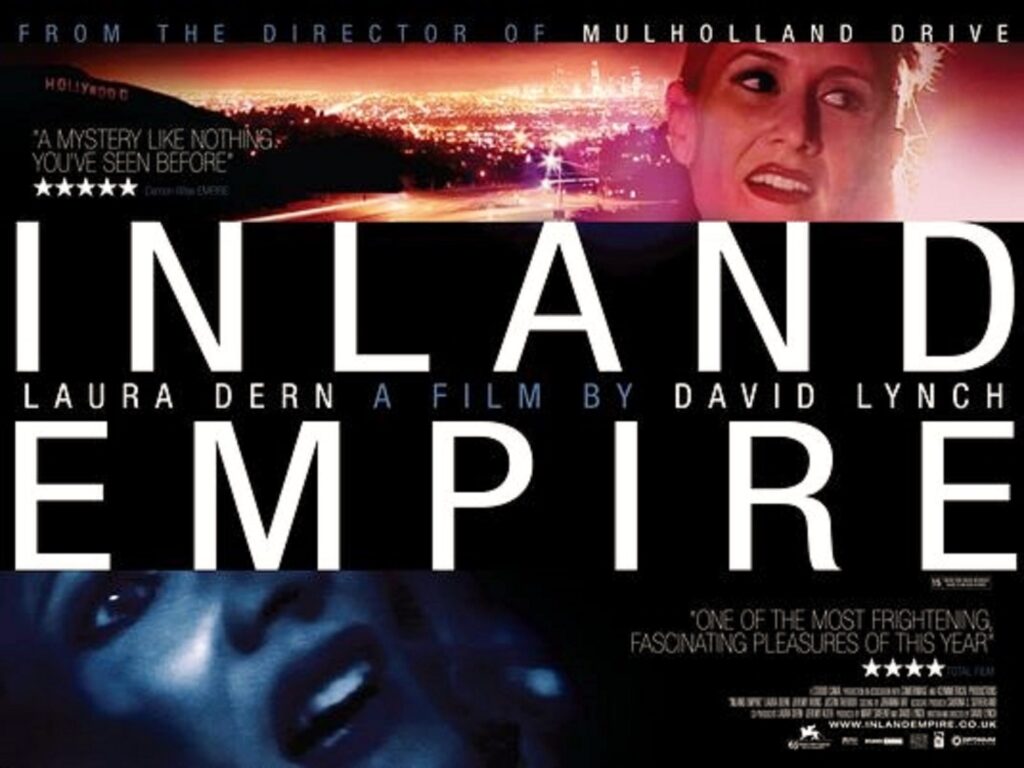
Original (American) poster of Empire of Dreams.
JJoão Rodolfo Franzoni is a journalist and professor..
 Portuguese
  English
  Spanish
  French