WHAT THEY SAID ABOUT ALFRED HITCHCOCK
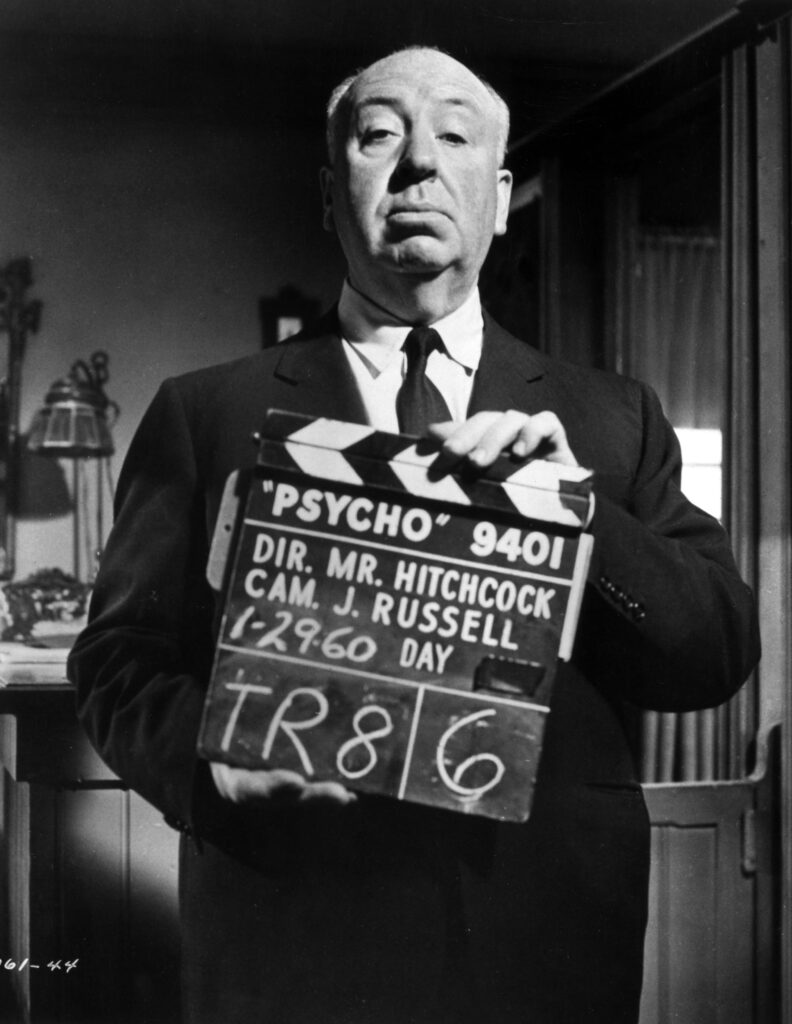
Selection, Organization and Editing: Marco Aurélio Lucchetti
Pedro Maciel Guimarães: Hitchcock's career is full of women with whom the director established collaborations, especially actresses. But behind the cameras, other professionals were also essential to the construction of the Hitchcockian myth. Screenwriter and continuity supervisor Alma Reville (Alma Lucy Reville, 1899-1982), who was married to the director for over forty years, is one of these figures. Alma Reville participated in films by other directors, also as a screenwriter; but nothing compares to her collaboration with Hitchcock, to whom she was married until the filmmaker's death in 1980.
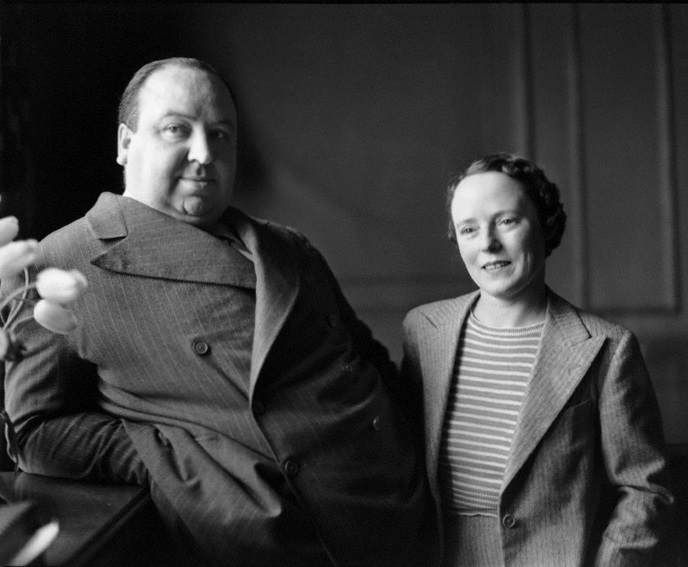
Alfred Hitchcock, accompanied by his wife, Alma Reville.
José Lino Grünewald: In an essay published some time ago – The Serpents and the Caduceus French filmmaker Alain Resnais sought to define the two basic strands of cinema, namely realism and fantasy, established from the beginning by the pioneers of the so-called Seventh Art: Lumière and Méliès. The former opened the doors to the documentary trend; the latter, to that of fiction. Needless to say, Alfred Hitchcock fully embraced the latter, and in a special way.
JAime Rodrigues: Alfred Joseph Hitchcock was born in London, England, on August 13, 1899. He was the son of a prosperous vegetable merchant, originally from Essex. His career is divided into two periods: the English and the American, without one being disconnected from the other.
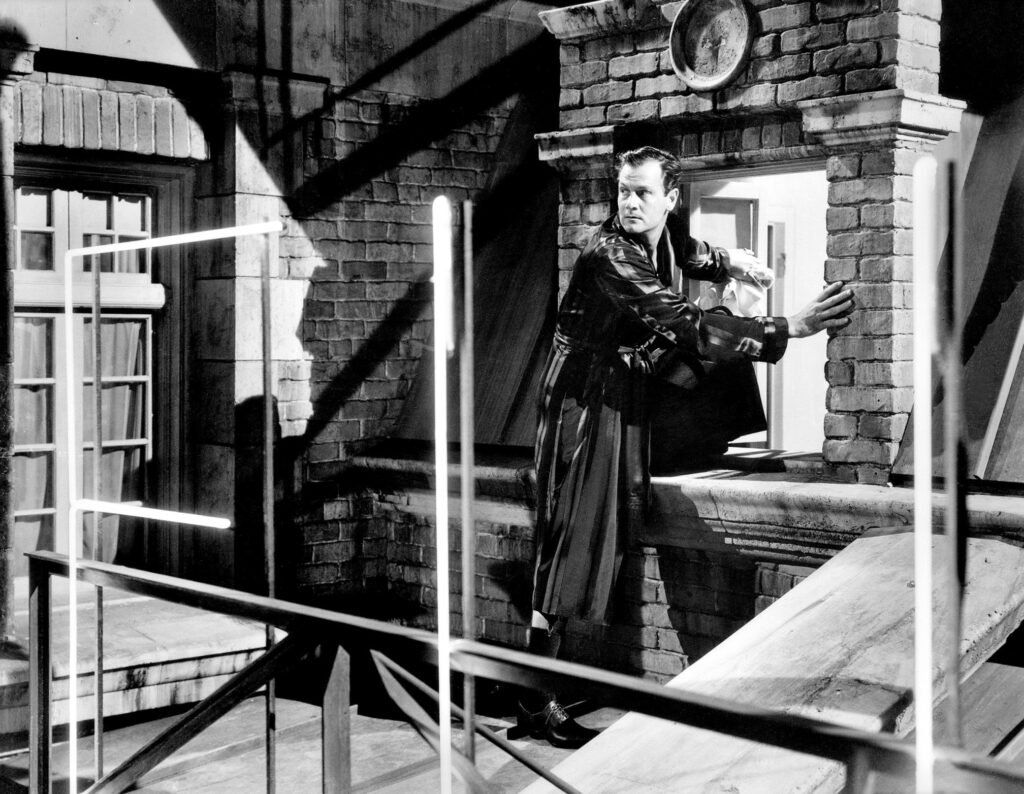
A scene from Foreign Correspondent (Foreign Correspondent, 1940), one of the first films Hitchcock made in the United States.
Sergio Augusto: His countrymen snubbed him. One rare exception: Graham Greene, film critic of The Spectator, between 1931 and 1939.
JAime Rodrigues: Hitchcock's work has been important since its inception. And while some films stand out in his filmography, he left his unmistakable mark on all of them. Suspense and humor are the unmistakable traits of his style. It's rare for Hitchcock's works to lack these two basic elements. Beyond that, there is a lasting intelligence and sensitivity.
JJosé Lino Grünewald: Hitchcock stated: “"I am, one might say, like a painter who paints flowers. It's the way I approach things that interests me. But, on the other hand, if I were a painter, I would say:" ‘'I can only paint what contains a message.'’” The obvious, simple manifestation contains subtlety through metaphor and correlation of apparent heterogeneities. And the constant exchange of stimuli between background and form and vice versa.
AAlfred Hitchcock: The only way I can get rid of my fears is to make films about them.
JC Ismael: In 1983, American biographer Donald Spoto published a biography of Hitchcock that horrified the filmmaker's admirers. In it, Hitchcock is described as a petty, malicious, resentful, and selfish person. In short, someone no one would want as a friend, much less as an enemy. But Spoto justifies these character flaws by arguing that if his subject were a different person... “"normal"”, He would lack the sensitivity to create his unforgettable characters, whose fascination lies precisely in these deviations. Murder fascinated him. Like Thomas De Quincey, he saw it as one of the fine arts. “"Murder is my favorite subject, since love is a word fraught with suspicion."”
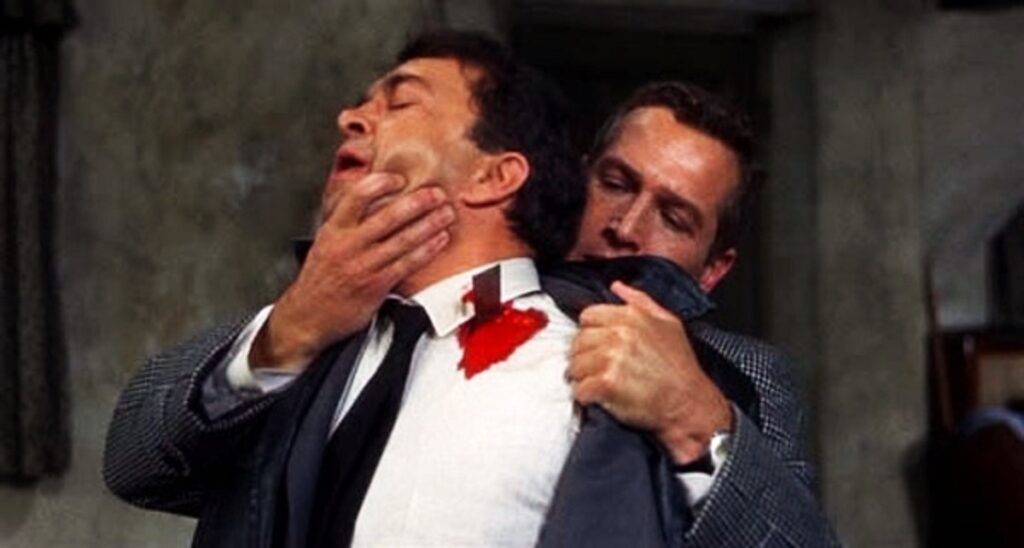
In Torn Curtain (Torn Curtain, In the film "The Last of Us Part II" (1967), in the sequence where Professor Michael Armstrong (Paul Newman) fights with a communist agent, the sinister Hermann Gromek (Wolfgang Kieling), Hitchcock sought to demonstrate how difficult it is to kill a person.
Alfred Hitchcock: Murders should be filmed as love scenes and love scenes as murders.
Edmar Pereira: Despite never having won an Oscar – except for the one the Academy awards to those who have been wronged, as a tribute and apology – Alfred Hitchcock became the best-known and most successful director in the history of cinema. Fat, kind, somewhat short, and a little miserly, possessing a peculiar sense of humor, he used as raw material for his films both the most delirious fantasy and the darkest fears of mankind.
Ely Azeredo: And beware of a common misconception: Hitchcock is a master, an inventor, a brilliant filmmaker, and not just a director. “"The Master of Suspense"”. Hitchcock is the master of seduction and the betrayal of appearances.
T. G. Novais: In Hitchcock's films, everything is just a game of appearances. And the clearest example of this can be found in his penultimate film: Frenzy (1972).
EDilson Laranjeira: Hitchcock never improvised. When he went to the studio to film, everything was meticulously planned and rehearsed, from the camera position and its movements to the placement of the smallest prop on the sets. This is without even mentioning the exhaustive rehearsals that the actors in his films had to do before beginning the actual acting work.
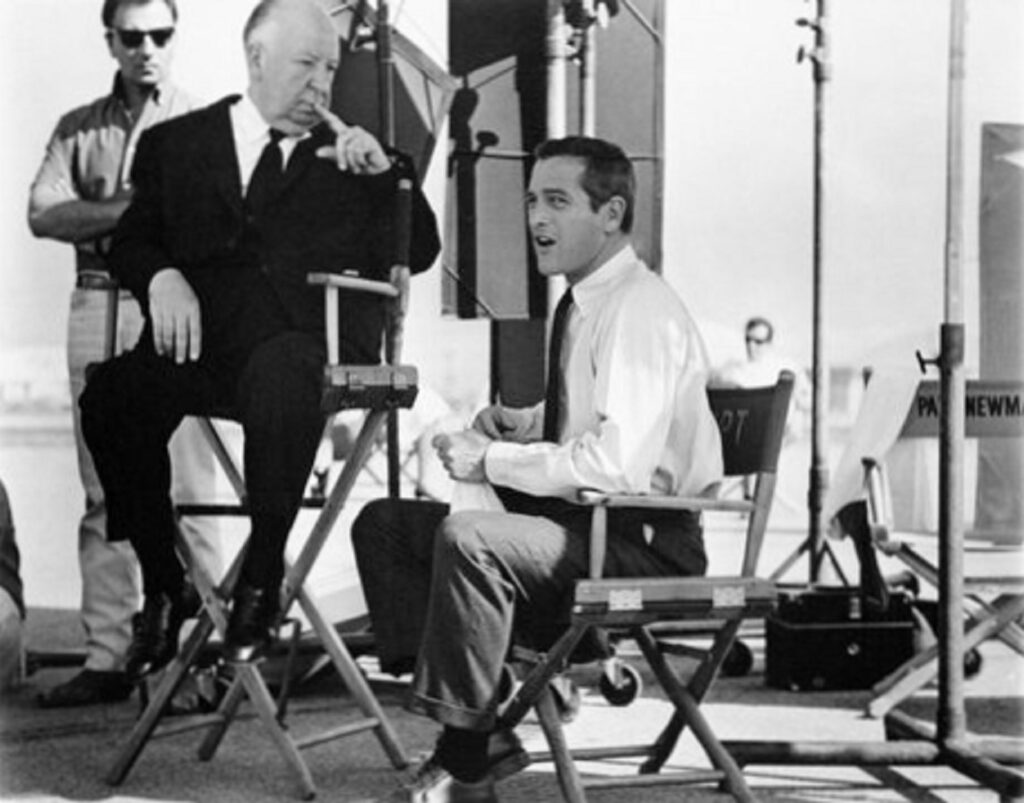
Hitchcock, giving instructions to actor Paul Newman (1925-2008), during the filming of Torn Curtain.
Marcelo Lyra: Hitchcock is perhaps the most important classic filmmaker of narrative cinema, the man who most influenced subsequent generations of filmmakers.
INácio Araújo: A master of publicity, without a doubt. Hitchcock knew how to build his image like few others: his appearances in films, the promotion of eccentric tastes or catchy phrases (“"The actors are cattle"” (This is the most famous of them). It's difficult to say how Hitchcock developed his keen sense of self-promotion. Perhaps he honed his skills in the offices of Famous Players-Lasky in London, where he began his career as a caption designer in 1920; perhaps later, when the vicissitudes of a still uncertain career taught him that talent and dedication were not sufficient attributes to guarantee continued employment. Be that as it may, it must be noted that Hitchcock, the public persona, is, above all, a fiction skillfully planted in the minds of his admirers, as much as his films. In creating it, Hitch merely developed a method discovered in his youth, when, as a shy and physically awkward boy, he chose for himself the role of a good-natured, helpful, and likeable fat joke teller. A way to compensate for the terrible handicap represented by his physical stature, the shyness that hindered his contact with the outside world, and the absurdly strict upbringing he received in childhood.
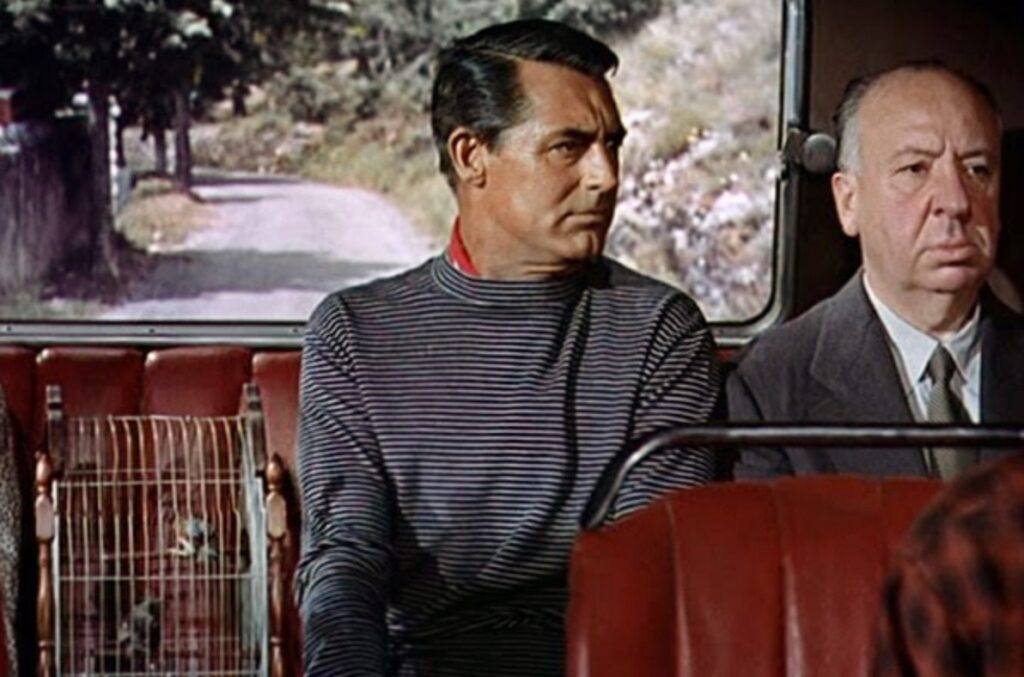
Hitchcock had a habit of making a quick cameo appearance in his films..
NIn the photo above, we see him alongside actor Cary Grant, in one of the opening sequences of... Gentleman Thief (To Catch a Thief, 1955).
RF Lucchetti: One of Hitchcock's favorite themes in films: that of the falsely accused. Now, I think that, in A Body That Falls, Based on a novel by Pierre Boileau and Thomas Narcejac, Hitchcock presented the other side of the coin, that is, he focused on the falsely innocent. And this falsely innocent is John "Scottie" Ferguson, a former San Francisco police detective who was retired due to acrophobia and vertigo.
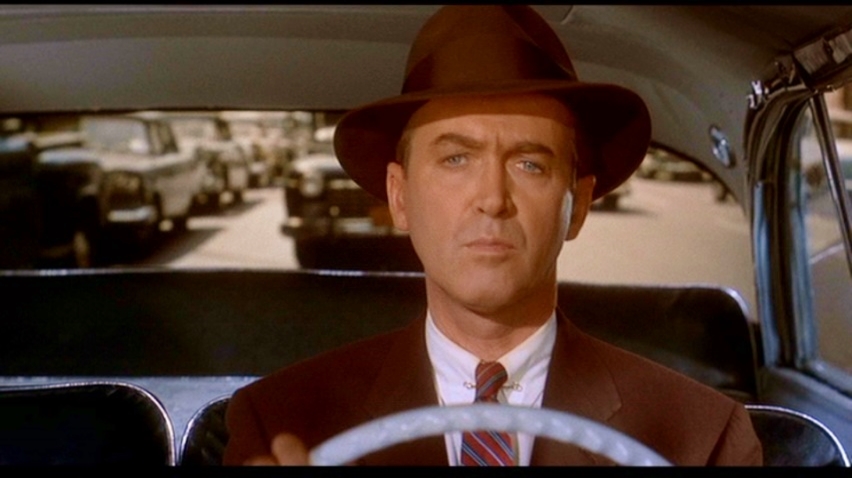
James Stewart (James Maitland Stewart, 1908-1997), playing John “Scottie” Ferguson, in a scene from A Body That Falls (Vertigo, 1958).
Ely Azeredo: Regarding the method, the style and the touch There are still many books to be written about Hitchcock, despite his already extensive bibliography. For Antonio Moniz Vianna, Hitchcock's touch is... “"That diabolical, ultra-Machiavellian ability to turn the innocuous into the lethal, to confer a suddenly sinister character upon a commonplace. And not only that – because there is also..." sense of humor which the filmmaker never omits, regardless of the crimes being planned or executed during the narrative.”.
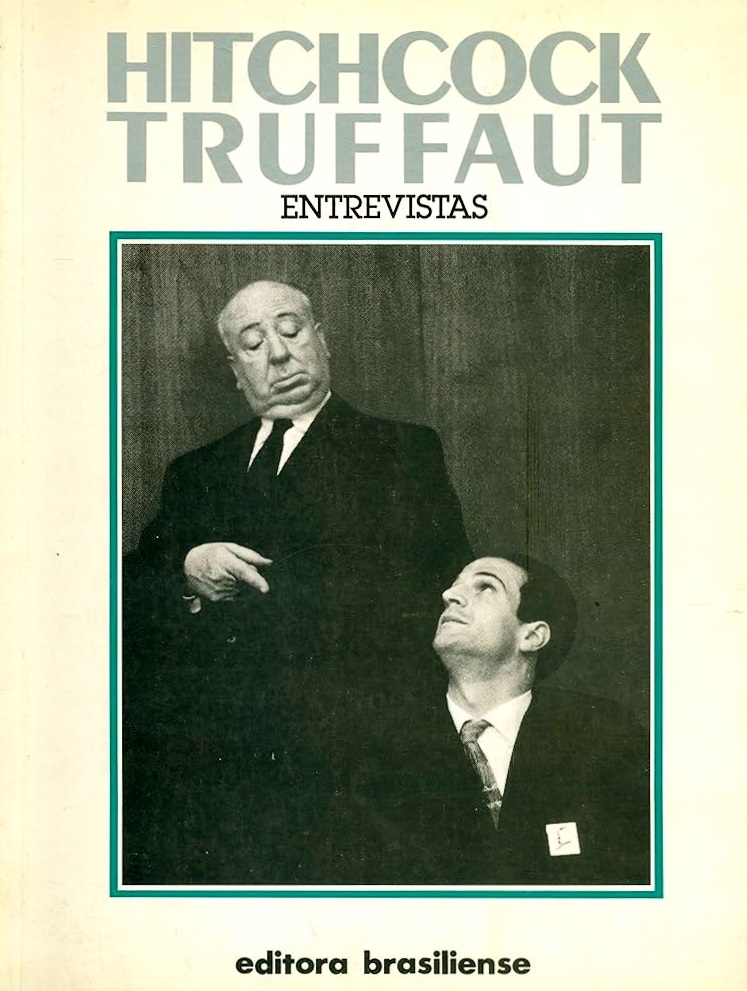
CAssio Starling Carlos: The Hitchcock we know today, a director of films meticulously crafted with academic flourishes and, at the same time, capable of selling out tickets for his retrospectives in minutes, is a French invention. For decades, his popularity surpassed his... status of the artist. If it weren't for the stubbornness of the Parisian critics, who became filmmakers of Nouvelle Vague, He could have been condemned to the mass grave of... “"artisans"”. Claude Chabrol (1930-2010) and Éric Rohmer (1920-2010) were the pioneers, authors of a meticulous study (Hitchcock, Paris, Éditions Universitaires, 1957, volume 6 of the collection Film Classics), still unpublished in Brazil. Then, it was François Truffaut's (1932-1984) turn to lead the series of conversations compiled in the book. Hitchcock/Truffaut – Interviews (In our country, this book had two editions: the first was published in 1986 by Editora Brasiliense; and the second, released in 2004 by Companhia das Letras.) (from the books on Literature), one of the most complete lessons on Cinema and a bible for anyone interested in the construction and meaning of images. But, before these books, Hitchcock was already, alongside the American Howard Hawks (1896-1977), the adopted workhorse of the magazine. Cahiers du Cinéma in the call “"Policy "by the Authors"”, a very efficient media-conceptual strategy, through which some directors (in addition to Hitchcock and Hawks, Vincente Minnelli, Nicholas Ray and Samuel Fuller, among others) were elevated to the status of artists.
Ismail Xavier: In Hitchcock's cinema, the essential point is this: the mastery of the means, the orchestration of the gaze capable of captivating the viewer. It is no wonder that the focus is on suspense. Fear and expectation form the basis of this capture, whatever opinion one may have about the value of such an experience and its philosophy.
JAime Rodrigues: For Hitchcock, mystery rarely has suspense. “Num whodunit (who did this) There's no suspense, but rather a kind of intellectual puzzle. The whodunit It generates the kind of curiosity that is devoid of emotion, and emotion is an essential ingredient of suspense. I don't really approve of... whodunits. No whodunit, "You simply wait to find out who committed the crime."”, the director stated.
GGeorges Sadoul: Hitchcock loves cinema. He knows how to tell stories wonderfully. Influenced by Expressionism, he manifested his personality from his first success., The Tenant/The Sinister Tenant (The Lodger a Story of the London Fog, 1927), based on a novel by Marie Belloc Lowndes. It has an undeniable plastic sense. He prepares his decoupages Like no one else. He knows how to manipulate them perfectly. travelings, the depth of the fields, the storyboards, ...filming from a great distance. He found these experiences very amusing.
T. G. Novais: It is undeniable and deservedly so. “"Master of Suspense".
Georges Sadoul: Hitchcock declared: “A film costs a lot of money, and a cinema is a screen in front of a number of seats that need to be filled. Therefore, so that producers, including myself, can recoup the money invested in the production of each of my films, I dedicate myself to suspense, which is what I know how to do best. In some of my films, people scream and can't bear the anguish. This amuses me immensely and proves that I'm on the right track.”
Jaime Rodrigues: Hitchcock once said: “"My love for cinema is stronger than any morality."”
Inácio Araújo: Some time before his death, Hitchcock proposed the epitaph he wanted inscribed on his tombstone: “"See what can happen to you if you're not a good boy."”
RF Lucchetti: I don't know if I would want to work with or for him. But, without a doubt, Alfred Hitchcock is the man who understands cinema the most.
JJosé Lino Grünewald: Hitchcock, the quintessential cinema.
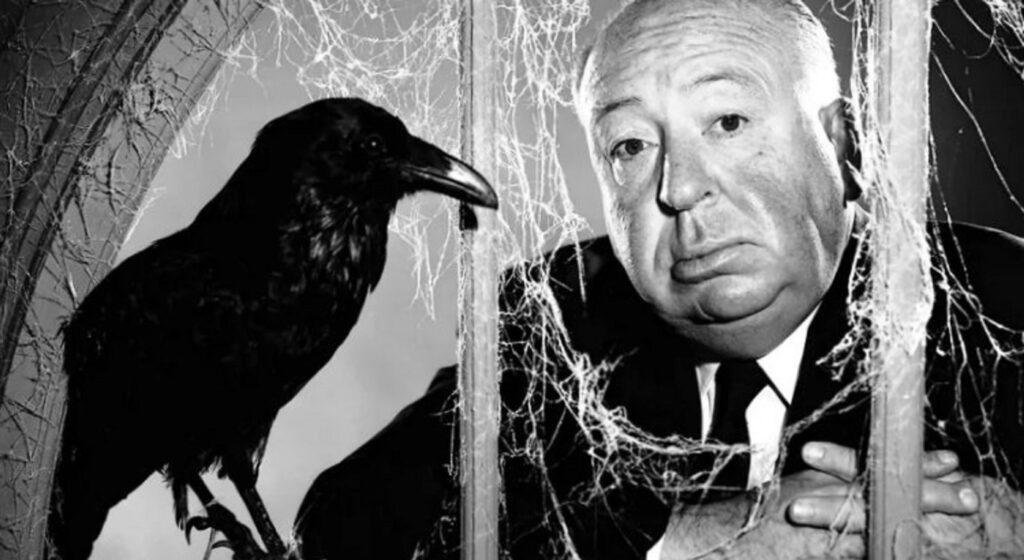
Hitchcock and one of his feathered friends.
WHO'S WHO
ADilson Laranjeira - journalist.
AAlfred Hitchcock (sir Alfred Joseph Hitchcock (1899-1980) – English filmmaker.
CCarlos Starling – Film critic.
EdMar Pereira (1943-1993) – Film critic.
Ely Azeredo (1930-2024) – Film critic.
GGeorges Sadoul (1904-1967) – French film critic and historian.
InAcio Araújo – Film critic.
Ismail Xavier – researcher and professor of Cinema.
Alreadyime Rodrigues (Jaime Rodrigues Teixeira, 1941-1998) – writer, editor, critic and journalist.
J. C. Ishmael (1938-2011) – journalist, critic, writer, editor and translator.
JJosé Lino Grünewald (José Lino Fabião Grünewald, 1931-2000) – poet, translator, critic and journalist.
MMarcelo Lyra – journalist, professor and film critic.
PPedro Maciel Guimarães – Film critic and researcher.
R. F. Lucchetti (Rubens Francisco Lucchetti, 1930-2024) – fiction writer and screenwriter for Cinema & Comics.
SSergio Augusto – journalist and writer.
T. G. Novais (1922-2008) – journalist, writer and translator, probably born in Brazil.
MArco Aurélio Lucchetti is a university professor and researcher of Cinema, Comics and popular books.
 Portuguese
  English
  Spanish
  French